20+Years Specialized Manufacturer Of Tower Cranes And Construction Hoists

Construction Hoist Safety Checklist: 10 Points Every Site Must Pass
7/15/20266 min read
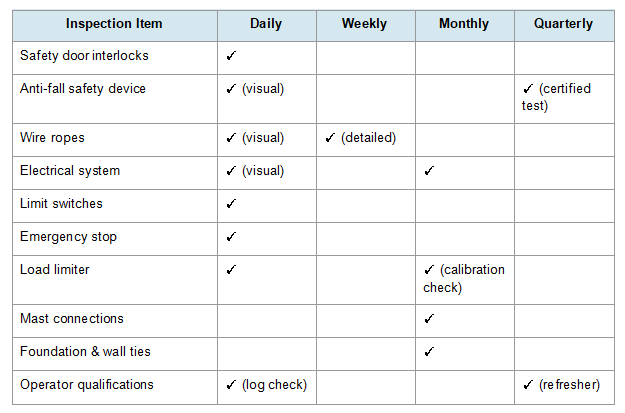
Post this table at the site safety office and treat it as your minimum standard.
How Smart Hoists Simplify Safety Inspection
Manual inspections are essential — but they depend on human discipline. That is why the industry is moving toward intelligent construction hoists that monitor safety-critical parameters in real time.
The GKZG SC200/200ZN Smart Construction Hoist is designed to address this challenge. Built on GKZG's decades of experience in lifting equipment manufacturing, the SC200/200ZN integrates:
• Automatic overload detection with real-time load display and automatic cut-off — no manual calibration required per shift.
• Self-diagnosing control system that alerts maintenance teams to electrical faults before they cause downtime.
• Encrypted operation logging that records every trip, load, and alarm event — providing auditable proof of compliance.
• Remote monitoring capability so site managers and safety officers can check hoist status from a mobile device.
For sites managing multiple hoists, these intelligent features dramatically reduce the burden of daily safety checks while improving accuracy. Learn more about the GKZG SC200/200ZN Smart Construction Hoist.
Explore our full range of construction hoist products to find the right solution for your project.
Need Help With Your Construction Hoist Safety?
A checklist is only as good as the team behind it. At GKZG we have been manufacturing and servicing construction hoists for over 20 years, with installations across more than 60 countries.
Whether you need:
• A free safety audit of your current hoist installation
• Operator training for your site team
• An equipment assessment to determine if an upgrade to a smart hoist makes sense for your project
Contact GKZG today — our engineering team is ready to support your safety goals.
Email: ann.lin@gkzgtowercrane.com
Website: gkzgtowercrane.com
Safety is not a checklist exercise. It is a culture. Start with the checklist — and build from there.
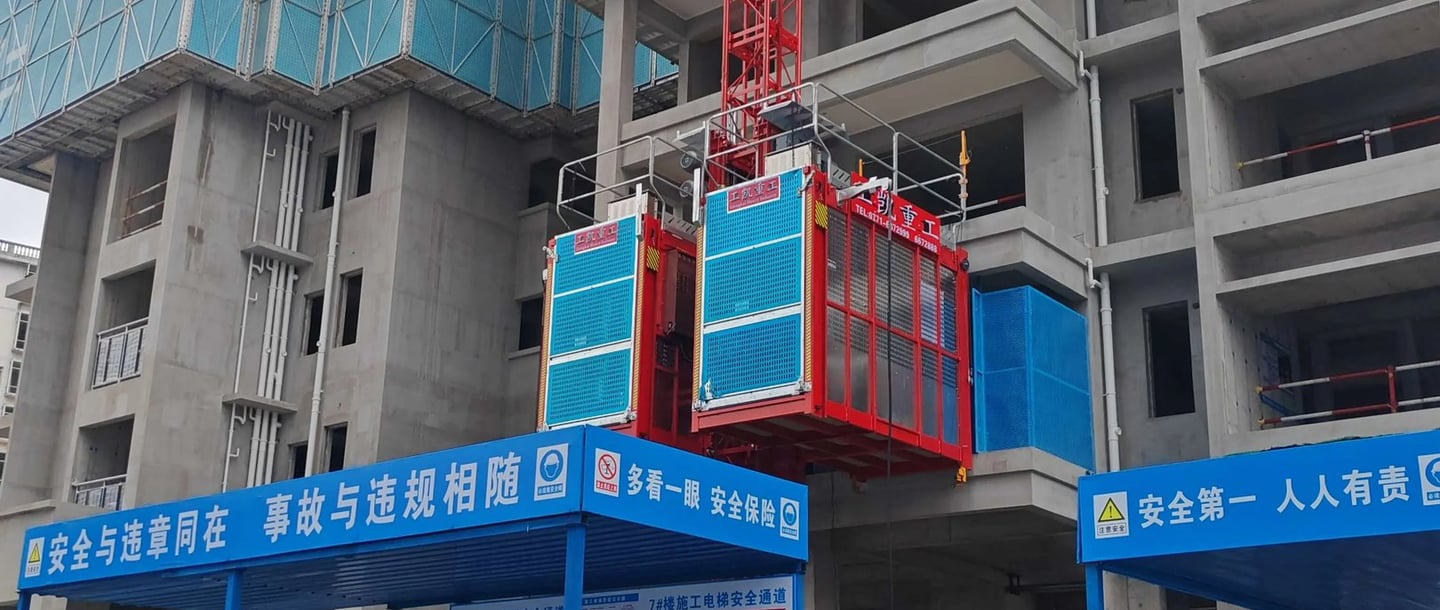
Every year, construction hoist accidents cause serious injuries and fatalities on job sites around the world. According to the International Labour Organization (ILO), falls from height remain one of the leading causes of death in construction — and a significant number of these incidents involve temporary lifting equipment such as construction elevators.
The good news? Most hoist accidents are preventable. A disciplined, documented construction hoist safety checklist can catch problems long before they turn into disasters. Whether you manage a high-rise project in Jakarta, a bridge job site in Lagos, or a residential tower in Dubai, this 10-point inspection guide will help you keep your crew safe, your project on schedule, and your operation in compliance.
Below is a field-tested construction elevator inspection checklist used by safety professionals across Southeast Asia, Africa, and the Middle East.
1. Safety Door Interlock Devices
Every landing gate and cage door must be fitted with a mechanical or electrical interlock. The interlock ensures the hoist cannot move unless all doors are fully closed — and doors cannot open while the cage is in motion.
What to check:
• Door interlocks engage smoothly with no visible damage.
• The cage does not move when any door is open (test before each shift).
• Replace worn springs, broken latches, or corroded wiring immediately.
Common issue: Workers sometimes wedge doors open with makeshift tools to speed up loading. This bypasses the safety system entirely and must be treated as a zero-tolerance violation.
2. Overspeed Governor / Anti-Fall Safety Device
The overspeed governor — also called the anti-fall safety device — is the single most critical component for preventing cage free-fall. When the cage exceeds a preset speed, the governor triggers the safety gear to clamp the mast and stop the descent.
What to check:
• The safety device is within its calibrated date (typically tested every 3 months).
• The activation speed matches the rated speed of the hoist (check the nameplate).
• After any activation, the device must be reset and re-certified by a qualified technician before use.
Standard reference: Most national regulations require anti-fall devices to be tested at least quarterly and after any abnormal event. Check your local building hoist safety regulations for exact intervals.
3. Wire Rope Condition
Wire ropes bear the entire load of the cage, passengers, and materials. A rope failure at height is catastrophic.
What to check:
• Visible broken wires: any rope with more than the allowable number of broken wires in one lay length must be replaced immediately.
• Diameter reduction: measure rope diameter with a caliper. A reduction of more than 6–10% from nominal indicates core failure.
• Kinks, bird-caging, corrosion, or flat spots.
• Proper lubrication — dry ropes wear significantly faster.
Frequency: Visual inspection daily; detailed measurement weekly.
4. Electrical Control System
Faulty wiring is a leading cause of unexpected hoist behavior, including uncommanded movement and loss of control.
What to check:
• Control panel: no burnt marks, loose connections, or moisture ingress.
• All cables are properly routed, secured, and free from abrasion.
• Grounding and insulation resistance meet the manufacturer's specification.
• Phase sequence and voltage are within tolerance (±10% of rated voltage).
Tip for tropical climates: In humid environments common across Southeast Asia and West Africa, moisture-related electrical faults are among the top causes of hoist downtime. Install drip loops on all outdoor cable entries and use IP-rated enclosures.
5. Limit Switches (Upper & Lower)
Limit switches prevent the cage from traveling beyond the top or bottom of its intended path. They act as the final safeguard against over-travel.
What to check:
• Upper limit switch: the cage must stop automatically before reaching the top of the mast.
• Lower limit switch: the cage must stop before the counterweight contacts the buffer.
• Both switches should be independently tested — never rely on a single switch as primary and backup.
Common issue: Limit switches that are improperly adjusted or held in the "triggered" position with tape or wire ties. This is extremely dangerous and must be corrected immediately.
6. Emergency Stop Device
An emergency stop (E-stop) must be accessible both inside the cage and at ground-level controls. It should cut power to the drive motor immediately upon activation.
What to check:
• E-stop buttons are clearly marked in red, unobstructed, and easily reachable.
• Pressing the E-stop stops all hoist movement within one second.
• The E-stop must remain locked in the "off" position until manually reset.
• Test the function at the start of every shift.
7. Load Limiter (Overload Protection)
Overloading is one of the most common — and most preventable — causes of construction hoist failure. A rated load limiter prevents the cage from operating when the load exceeds the safe working load (SWL).
What to check:
• The load limiter is calibrated and displays the current load clearly to the operator.
• The alarm triggers at approximately 90% of SWL; the cut-off engages at 110% of SWL.
• The system prevents cage movement when overloaded (verify with test weights during commissioning).
• Check that the load sensor is free from mechanical damage or debris buildup.
Real-world tip: On busy sites, material loading is often done by crane operators who are not hoist operators. Clear signage showing the SWL in both kg and common material equivalents (e.g., "Max: 20 bags of cement + 4 workers") dramatically reduces overload incidents.
8. Mast Section Connections
The mast (tower) is assembled from modular sections bolted together. Loose or missing bolts compromise the structural integrity of the entire hoist system.
What to check:
• All mast connection bolts are present and torqued to the manufacturer's specification.
• No visible cracks, deformation, or corrosion on mast chords or bracing members.
• Rack and pinion engagement: teeth must be clean, properly aligned, and show no excessive wear.
• Mast verticality: check with a theodolite or plumb line. Tolerance is typically H/1000 (e.g., 100 mm deviation max for a 100 m mast).
When to inspect: After every mast extension, after high winds or seismic events, and at minimum monthly during continuous operation.
9. Foundation and Wall Ties
A construction hoist is only as safe as its foundation and lateral support. Poor ground conditions or missing wall ties can lead to mast collapse.
What to check:
• Foundation: concrete pad is level, free from cracking, and meets the engineered design (minimum dimensions and reinforcement per manufacturer specs).
• Anchor bolts: all present, tight, and no signs of pull-out or concrete spalling.
• Wall ties (tie-ins): installed at the correct vertical spacing (typically every 6–9 meters) and horizontal distance from the building face.
• No unauthorized modifications to tie-in points (e.g., ties attached to scaffolding instead of the structure).
10. Operator Qualification and Training
Even a perfectly maintained hoist is unsafe in untrained hands. Every operator must hold a valid certification and understand the specific model they are operating.
What to check:
• Operator holds a current, government-recognized hoist operator license or certificate.
• The operator has received model-specific familiarization training from the manufacturer or an authorized trainer.
• A pre-shift inspection log is completed and signed before the first run each day.
• The operator can demonstrate correct response to alarm conditions (overload warning, E-stop, power failure).
Industry best practice: Conduct refresher training every 6 months. Keep a training log on site as part of your construction hoist maintenance documentation.
Recommended Inspection Frequency
Connect GKZG
Get in touch for your project needs today.
Contact us
Tel/Whatsapp/Wechat:+86 19377161135
Copyright © 2026. Guangxi Gongkai Heavy Industry Manufacturing Co.,Ltd.All Right Reserved
Address: No.12 Fuqiao Avenue, Longan Overseas Chinese Administration District, Nanning, Guangxi,China