20+Years Specialized Manufacturer Of Tower Cranes And Construction Hoists

How to Choose the Right Generator Set for Construction Sites
7/22/20263 min read
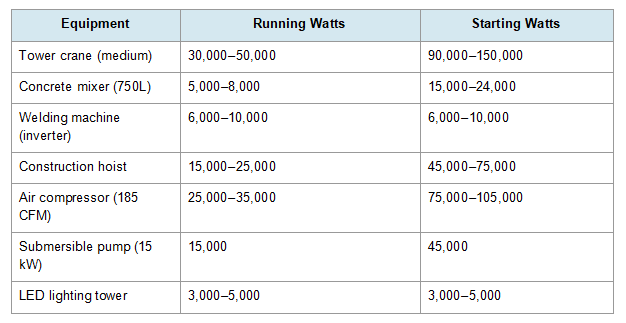
Always size based on combined starting surge, not just running totals.
Quick Maintenance Tips
• Daily: Check oil, coolant, fuel level, and inspect for leaks.
• Every 250 hours: Change oil and filters.
• Every 500 hours: Inspect air filters and battery. Replace filters more often in dusty conditions.
• Every 1,000 hours: Full service — valve clearance, injector check, belt inspection.
• Always: Keep the unit clean, covered, and ventilated. Log running hours.
Proper maintenance extends generator life by 30–50% and prevents costly downtime.
Why Choose GKZG Generator Sets
Guangxi Gongkai Heavy Industry (GKZG) is a proven heavy machinery manufacturer — not a trading company. With a 60,000 m² manufacturing facility, CE and ISO certifications, and 38 national patents, GKZG brings the same engineering rigor used in our tower cranes and construction hoists to our new generator set product line.
• Original manufacturer — Every unit is assembled and tested in-house. No rebadging.
• Full product range — From 20 kVA portable units to 500+ kVA industrial diesel generator sets.
• Built for harsh environments — Oversized cooling, heavy-duty filtration, reinforced enclosures designed for Southeast Asia, Africa, and Central Asia.
• System compatibility — Our generator sets integrate seamlessly with GKZG tower cranes and construction elevators — a single-source power and machinery solution.
• Certified quality & after-sales — CE/ISO certified with localized support and spare parts in key export markets.
Get Expert Sizing Advice — Contact GKZG Today
Whether you need a 20 KVA portable unit for a road crew or a 400 KVA diesel generator set for a high-rise project, our engineering team can help you calculate the exact capacity your site requires.
Website: gkzgtowercrane.com
Email: ann.lin@gkzgtowercrane.com
WhatsApp: +86 19377161135
Let us power your next project — reliably, efficiently, and backed by a manufacturer you can trust.


Construction sites are among the most demanding environments for power supply. Unlike factories with stable grid connections, a construction site relies on temporary, mobile, and highly durable power sources. Dust, extreme temperatures, heavy rain, and fluctuating loads all challenge your equipment every single day.
A reliable generator set for construction is not a luxury — it is a necessity. Without stable power, cranes stop, welding machines go offline, and project timelines collapse.
This guide covers the 5 key factors every project manager should consider when selecting a construction site generator, plus a practical load reference table and maintenance tips.
Why Construction Sites Have Unique Power Demands
Construction power needs differ from standard use in three ways:
1. Temporary supply — Grid connections are often unavailable or unreliable, especially in Southeast Asia, Africa, and Central Asia.
2. Harsh conditions — Generators run in dust, humidity, and temperatures far beyond standard 25°C ratings.
3. Load fluctuations — A tower crane drawing 80 kVA at startup may drop to 20 kVA during operation. These spikes require generous headroom.
5 Key Factors for Choosing a Generator Set
1. Calculate Total Power Demand (KVA)
The most common mistake is undersizing. Follow this method:
• List every piece of equipment running simultaneously.
• Note running watts and starting watts (starting watts can be 3–5× for motors).
• Add the starting wattage of the largest load to the running wattage of all others.
• Convert: kVA = kW ÷ Power Factor (use PF = 0.8 for construction equipment).
• Add a 20–25% safety margin.
Example: Running load = 120 kW, largest motor starting surge = 80 kW → peak = 200 kW → 200 ÷ 0.8 = 250 kVA → select a 250–300 kVA generator set.
2. Choose the Right Fuel Type
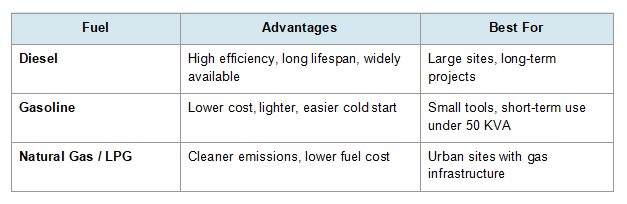
For most sites in emerging markets, diesel generators remain the standard — fuel is readily available and engines handle heavy loads better.
3. Decide: Mobile vs. Stationary
• Mobile / Trailer-Mounted (20–200 kVA): Ideal for road construction, multiple short-term sites, and finishing-stage work. Easy to tow between locations.
• Stationary / Skid-Mounted (100–2000+ kVA): Best for large building projects with tower cranes and construction hoists. Fixed installation with proper grounding delivers more stable output.
If your project involves heavy equipment like tower cranes and construction elevators, a stationary unit usually makes more sense. For smaller crews and roadwork, portable generator units are essential.
4. Ensure Environmental Adaptability
Sites in tropical and arid regions demand generators built for extreme conditions:
• High temperature (45–50°C): Confirm the generator's continuous rating at site temperature, not just the ISO-standard 25°C rating. Oversized radiators are critical.
• High humidity & dust: Look for IP23+ enclosure protection and serviceable air filters.
• Altitude: Above 1,000 m, expect 3–5% derating per 300 m.
A generator designed for heavy-duty industrial use — with reinforced cooling and dust-resistant enclosures — will significantly outlast a standard commercial unit.
5. Meet Noise and Emission Regulations
Urban construction sites often face noise limits of 65–75 dB(A) at 7 meters. Sound-attenuated enclosures are essential for night work and city-center projects. Check local emission standards — international contractors may require Tier 3 / Stage IIIA compliant engines.
Common Construction Equipment — Power Reference
Connect GKZG
Get in touch for your project needs today.
Contact us
Tel/Whatsapp/Wechat:+86 19377161135
Copyright © 2026. Guangxi Gongkai Heavy Industry Manufacturing Co.,Ltd.All Right Reserved
Address: No.12 Fuqiao Avenue, Longan Overseas Chinese Administration District, Nanning, Guangxi,China