20+Years Specialized Manufacturer Of Tower Cranes And Construction Hoists

How to Choose the Right Tower Crane for High-Rise Construction
6/27/20264 min read
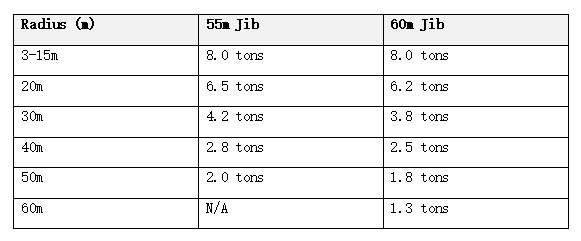
Always consult the manufacturer's specific load chart for your exact model and configuration.
Common Mistakes in Tower Crane Selection
Mistake #1: Underestimating Load Requirements
Solution: Calculate the heaviest single lift, including rigging weight. Add 20% safety margin.
Mistake #2: Ignoring Wind Conditions
Solution: For coastal or exposed sites, select cranes with higher wind resistance ratings. QTZP flat-top models perform better in high-wind environments.
Mistake #3: Insufficient Hook Height
Solution: Work backward from roof level. Account for hoist rope dead wrap, block height, and clearance to final concrete pour.
Mistake #4: Neglecting Ground Bearing Capacity
Solution: Conduct geotechnical surveys. Select appropriate foundation system (concrete pad, rail system, or pile foundation) based on soil conditions.
Mistake #5: Choosing Based on Price Alone
Solution: Consider total cost of ownership including: maintenance costs, availability of spare parts, manufacturer's service support, and certification standards (CE/ISO).
Frequently Asked Questions
Q1: What is the typical lifespan of a tower crane in high-rise construction?
A: With proper maintenance, tower cranes can operate for 15-20 years. Key lifespan factors include: usage hours, environmental conditions, maintenance quality, and adherence to inspection schedules.
Q2: How do I determine the number of tower cranes needed for a project?
A: Calculate based on: daily concrete pour volume, material delivery schedule, and critical path dependencies. Most medium-sized high-rise projects (20-30 floors) require 1-2 tower cranes, while larger developments may need 3-4 coordinated units.
Q3: What certifications should a tower crane manufacturer have?
A: Look for CE certification (EU safety standard), ISO 9001 (quality management), and ISO 14001 (environmental management). These indicate the manufacturer meets international safety and quality benchmarks.
Q4: Can tower cranes be used in earthquake-prone regions?
A: Yes, but special design considerations are required. Select cranes with enhanced seismic ratings, ensure proper anchoring systems, and consult with structural engineers for site-specific seismic analysis.
Q5: What is the difference between internal and external climbing cranes?
A: Internal climbing cranes are assembled inside the building core and climb with the structure; ideal for super high-rise. External climbing cranes use the building exterior or tower sections; better for medium-rise with available ground space.
Conclusion
Selecting the right tower crane for high-rise construction requires careful analysis of building height, lifting capacity, jib length, site constraints, and operational coordination. QTZP flat-top cranes are optimal for super high-rise projects exceeding 20 floors, while QTZ hammerhead cranes remain excellent choices for urban sites with space limitations.
Key Takeaways:
• Match crane capacity to your heaviest typical load + 20% safety margin
• Select hook height 5-10m above roof level
• For projects >25 floors, prefer QTZP flat-top cranes
• Always verify CE and ISO certifications
• Request manufacturer load charts and conduct detailed site analysis
Get Expert Consultation
GKZG is a professional tower crane manufacturer with 60,000㎡ manufacturing facility, CE & ISO 9001 certifications, and 38 patents in lifting technology. Since 2005, we have been producing QTZP flat-top and QTZ hammerhead tower cranes for global construction projects.
Contact our technical team for customized crane selection support:
• Email: ann.lin@gkzgtowercrane.com
• WhatsApp: +86 19377161135
• Website: https://gkzgtowercrane.com


Executive Summary
Selecting the appropriate tower crane for high-rise construction is critical to project efficiency, safety, and cost control. The right crane depends on five key factors: building height, lifting capacity, jib length, site constraints, and multi-crane coordination. For projects exceeding 100 meters, QTZP flat-top cranes offer superior jack-up capabilities, while QTZ hammerhead cranes excel in confined urban sites. Always verify manufacturer certifications (CE/ISO), request load chart documentation, and consult technical specialists before finalizing your equipment choice.
5 Key Factors in Tower Crane Selection
1. Building Height & Hook Height
The primary consideration when selecting a tower crane for high-rise construction is matching the crane's maximum hook height to your building's requirements.
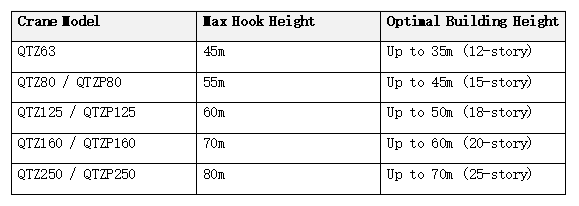
Pro Tip: Add 5-10 meters to your building height for safety margin and temporary works clearance.
2. Lifting Capacity Requirements
High-rise construction demands precise matching between crane capacity and typical load weights:
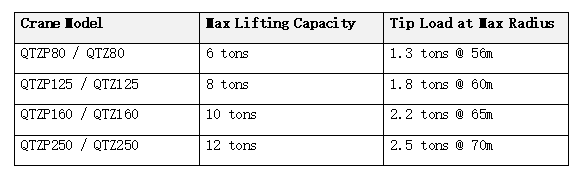
Common loads in high-rise construction:
• Reinforced concrete columns: 2-5 tons
• Steel beams: 1-3 tons
• Precast panels: 1.5-4 tons
• Formwork systems: 0.5-2 tons
3. Jib Length & Working Radius
The jib (working arm) length determines how far the crane can reach across the construction site:
• Urban high-rise (narrow site): 50-56m jib provides optimal coverage with minimal tail swing
• Large commercial projects: 60-65m jib for maximum coverage
• Mixed-use developments: 65-70m jib for flexible material placement
Critical Consideration: Ensure the jib length accounts for:
• Building footprint + 3-5m clearance
• Adjacent structures or power lines
• Ground-level material stacking zones
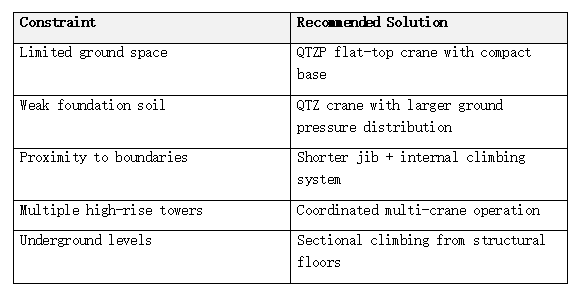
4. Site Constraints & Ground Conditions
Site limitations significantly impact crane selection:
5. Multi-Crane Operations
For large-scale high-rise projects, multi-crane coordination requires careful planning:
• Non-overlapping working zones to prevent collision
• Complementary capacity ranges (e.g., one 12t crane for heavy lifts + one 6t crane for finishing materials)
• Synchronized jib heights during overlapping working zones
• Unified communication protocols and signal systems
Flat Top vs Hammerhead for High-Rise
Choosing between flat-top (QTZP) and hammerhead (QTZ) tower cranes depends on your project's specific requirements:
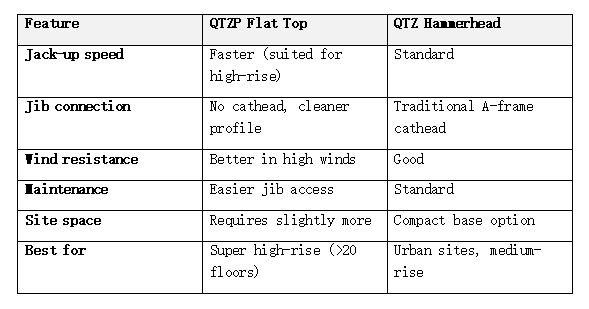
For projects above 25 stories: [Internal Link: /blog/flat-top-vs-hammerhead-tower-crane] — QTZP flat-top cranes are strongly recommended due to their faster climbing efficiency and superior wind resistance at greater heights.
Understanding Load Charts
A load chart (or load rating chart) is essential for safe crane operation. Here's how to read one:
Key Elements of a Load Chart:
1. Radius vs. Load Table
◦ Shows maximum safe load at each jib radius
◦ Load decreases as radius increases
2. Jib Combination Data
◦ Different jib lengths have different capacity ratings
◦ Always use the correct jib configuration table
3. Freestanding Height
◦ Maximum height without external support
◦ Decreases with longer jib lengths
Example: QTZP125 Load Chart (Simplified)
Connect GKZG
Get in touch for your project needs today.
Contact us
Tel/Whatsapp/Wechat:+86 19377161135
Copyright © 2026. Guangxi Gongkai Heavy Industry Manufacturing Co.,Ltd.All Right Reserved
Address: No.12 Fuqiao Avenue, Longan Overseas Chinese Administration District, Nanning, Guangxi,China