20+Years Specialized Manufacturer Of Tower Cranes And Construction Hoists

Tower Crane Maintenance: A Complete Guide for Site Managers
7/17/20263 min read
Most failures are preventable with disciplined inspection and timely intervention.
Smart Monitoring: The Future of Tower Crane Servicing
The industry is rapidly adopting IoT-based monitoring systems. These systems use sensors to track load and moment in real time, detect structural strain before cracks appear, and monitor environmental conditions to trigger automatic shutdown protocols.
Smart monitoring transforms maintenance from reactive to data-driven. Instead of waiting for failures, you receive early warnings and plan repairs during scheduled downtime.
Several GKZG tower crane models come equipped with integrated monitoring systems compatible with modern smart add-ons, making predictive maintenance easier to implement.
Related reading: Not sure which crane fits your project? Check our Tower Crane Selection Guide for a step-by-step framework.
Maintenance Records and Compliance
Proper documentation is as important as the physical maintenance itself. Your record-keeping system should include:
1. Daily inspection logs — signed by the operator
2. Weekly/monthly reports — with photos of defects found
3. Maintenance work orders — what was done, when, by whom
4. Load test certificates — updated after major repairs
5. Wire rope inspection records — with diameter measurements
6. Operator training records — for certification compliance
A well-maintained log helps predict component replacement needs, supports warranty claims, and protects your company during incident investigations.
How GKZG Supports Your Maintenance Operations
GKZG (Guangxi Gongkai Heavy Industry Manufacturing Co., Ltd.) has supported construction companies in over 50 countries since 2005. Our after-sales service includes:
• Genuine spare parts with fast international delivery
• 24/7 remote technical support via WhatsApp and email
• On-site service — engineers dispatched within 48 hours for major issues
• Video-guided maintenance for routine servicing
• Operator and maintenance training for your team
We provide complete maintenance documentation with every crane, including inspection checklists, lubrication schedules, and spare parts lists.
Take Action Today
Start by implementing the inspection checklist above, build your maintenance log system, and ensure your team has access to genuine parts and technical guidance.
Contact the GKZG team — we will help you keep your cranes safe, compliant, and productive.
Explore more in the GKZG Knowledge Center or visit our products page


Every year, crane-related incidents cause dozens of fatalities and hundreds of injuries worldwide. According to the Crane Inspection & Certification Bureau (CICB), over 90% of crane accidents are caused by human error — and many trace back to skipped inspections or poor maintenance practices.
For site managers in Southeast Asia, Africa, and the Middle East, where extreme heat, dust, and tight schedules put extra stress on equipment, a reliable tower crane maintenance program is essential. It is the most effective way to prevent accidents, avoid costly downtime, and extend your crane's service life.
This guide covers the key practices you need.
Why Regular Tower Crane Maintenance Matters
The cost of neglecting tower crane servicing goes far beyond repair bills:
• Unplanned downtime costs 3 to 5 times more than planned maintenance, due to emergency parts shipping, overtime labor, and idle crews
• A single breakdown can stall an entire project phase — concrete pours are delayed, steel erection halts, and workers stand idle
• The average cost per major injury reaches approximately $200,000; a fatality exceeds $4 million in combined losses
• Regulatory penalties for non-compliance are increasing globally — a failed inspection can shut down your site
Regular construction crane maintenance is not an expense. It protects your profitability and your people.
Tower Crane Inspection Checklist
A structured inspection routine catches problems before they become failures.
Daily Checks (Before Each Shift)
• Wire ropes: Look for broken wires, kinks, corrosion, or improper spooling
• Safety devices: Test hoist limit, trolley limit, and load moment limiter
• Brakes: Check for proper stopping distance
• Hook and block: Inspect for cracks, deformation, or worn safety latch
• Visual walk-around: Look for loose bolts, oil leaks, or structural damage
Weekly Checks
• Slewing bearing: Check for abnormal noise, smooth rotation, and grease level
• Hydraulic system: Inspect hoses, fittings, and fluid levels
• Electrical system: Check cable condition, connector tightness, and panel indicators
• Structural connections: Inspect bolted joints on mast sections and foundation anchors
• Lubrication: Grease all points per the manufacturer's schedule
Monthly Checks
• Wire rope diameter measurement: Track wear rate over time
• Load test: Verify brake performance and structural integrity
• Slewing bearing bolt torque: Retorque per OEM specifications
• Foundation inspection: Check for settling, cracks, or water accumulation
• Paint and corrosion: Touch up damaged coating, especially in coastal areas
Key Component Maintenance
Wire Ropes
Wire ropes are the most critical wear component. Lubricate regularly, replace when broken wires exceed ISO 4309 discard criteria, and monitor for diameter reduction. In tropical climates, inspect more frequently for salt-air corrosion.
Slewing Bearing
This bearing supports the entire upper structure. Maintain proper grease, listen for grinding sounds, retorque mounting bolts every 500 operating hours, and keep seals intact to prevent dust ingress — a common failure cause in desert environments.
Hydraulic System
Use clean, specified hydraulic fluid. Replace filters at recommended intervals, inspect hoses for abrasion or bulging, and bleed the system after any repair. Contamination is the number one cause of hydraulic failure.
Electrical System
Check cable insulation for cracks, keep control panels clean and dry, verify all grounding connections, and test emergency stop circuits monthly.
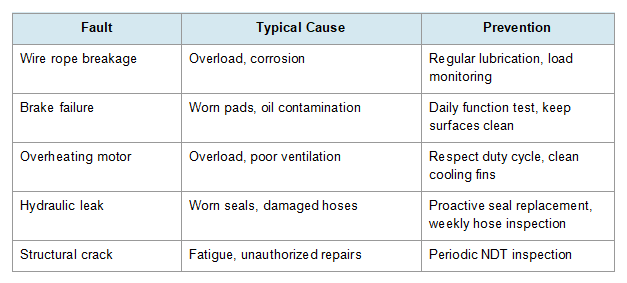
Common Faults and Prevention
Connect GKZG
Get in touch for your project needs today.
Contact us
Tel/Whatsapp/Wechat:+86 19377161135
Copyright © 2026. Guangxi Gongkai Heavy Industry Manufacturing Co.,Ltd.All Right Reserved
Address: No.12 Fuqiao Avenue, Longan Overseas Chinese Administration District, Nanning, Guangxi,China